A thirty-minute home vinyasa practice succeeds or fails on the discipline of its architecture. When you practice without a teacher pacing the room, minutes disappear into aimless adjustments, water breaks, or unfocused floor stretches. A short session cannot replicate the broad arc of a seventy-five-minute studio class, nor should it try. It demands a stripped-down, athletic logic that treats time as a fixed constraint, prioritizing joint preparation and clear movement pathways over decorative transitions.
To make half an hour effective, you must abandon the idea that every sequence requires a dozen distinct postures. Instead, build your practice around mechanical coherence: choose one movement pattern or anatomical focus, warm the precise tissues that support it, stress those tissues through progressive standing sequences, and wind down with enough time to lower your core temperature and down-regulate your nervous system. Thirty minutes executed with clear intent builds more functional strength and mobility than an hour of distracted improvising.
Time Allocation: Dividing the Thirty Minutes
Every minute of a compressed session requires a clear objective. Splitting your practice into distinct temporal blocks prevents the common trap of spending twelve minutes warming up, rushing through complex postures, and cutting the cooldown to thirty seconds because your schedule ran out. Use a physical timer placed outside your direct line of sight rather than checking your phone screen throughout the practice.
The allocation below provides a reliable template for a balanced thirty-minute sequence. It preserves room for physiological preparation and nervous system recovery while dedicating the majority of your time to active, load-bearing work.
| Segment | Duration | Primary Physiological Goal | Key Elements |
|---|---|---|---|
| Joint Articulation | 4 minutes | Synovial fluid distribution and active range assessment | Ankle dorsiflexion, hip rotations, wrist prep |
| Foundational Flow | 6 minutes | Core temperature elevation and breath pacing | Surya Namaskar variants with continuous breathing |
| Escalating Ladder | 12 minutes | Muscular endurance, balance, and peak loading | Standing postures linked with repeating, compounding transitions |
| Floor Counter-Postures | 5 minutes | Tissue decompression and heart rate reduction | Seated twists, passive hip opening, gentle forward folds |
| Physiological Down-Regulation | 3 minutes | Parasympathetic shift and baseline recovery | Corpse pose (Savasana) or supported constructive rest |
Respect the transition points between these blocks. If you find yourself lingering in your warm-up past the ten-minute mark, your standing work will suffer from truncated rest periods or sloppy form caused by rushing. Keep an analog wall clock within view to monitor your splits without breaking movement flow.
Joint Articulation: Preparing Ankles and Hips
Vinyasa yoga puts sudden, repetitive demands on the peripheral joints. Dropping directly into downward-facing dog or deep lunges without priming your ankles and hips invites compensation from the lumbar spine and knees. Spend the first four minutes moving your joints through active, unweighted ranges of motion on the floor before you bear full body weight on them.
Start in a quadruped position on hands and knees to prepare the wrists and ankles simultaneously. Turn your fingers backward toward your knees, keeping the heels of your hands grounded, and rock your pelvis back toward your heels for eight controlled pulses. Follow this by tucking your toes completely under, ensuring the pinky toes make contact with the mat, and sitting back onto your heels in a toe-squat position. Hold for twenty seconds while rolling your wrists through full circles. This simple loading forces blood into the plantar fascia and calf complex, preparing your feet for the rapid balance corrections required in standing flows.
Transition directly to the hips using a seated 90/90 position. Sit on the floor with your lead leg bent at ninety degrees in front of you and your trail leg bent at ninety degrees to the side. Without using your hands for support, keep your heels pinned to the floor and rotate your knees across the midline to switch sides. Perform six slow repetitions per side, pausing for three seconds at the end-range of internal rotation on the back hip. If your hips pinch or your pelvis tilts back significantly, place your hands behind your hips for support. If you have a history of hip labral tears or knee injuries, consult a physical therapist before forcing internal hip rotation under tension.
Finish this preparatory block with five slow cat-cow cycles, coordinating spinal extension with inhalation and spinal flexion with exhalation. Emphasize movement in the thoracic spine rather than dumping stress into the mobile cervical and lumbar regions. By the end of minute four, your joints will have moved through their basic axes, and you can step into weight-bearing postures without cold, stiff tissues.
Building Escalating Ladders Without Wasted Motion
In a thirty-minute practice, you do not have time for decorative flourishes or elaborate transitional choreography. An escalating ladder is the most time-efficient method for building heat and physical work capacity. A ladder introduces a short sequence of three postures on the right and left sides, repeats that sequence, and then adds two or three new postures to the chain with each cycle.
To eliminate wasted motion, cut out the habit of taking a full vinyasa (plank to chaturanga, upward dog, downward dog) between every single posture. A standard sixty-minute class often contains twenty or more chaturangas, which exhausts the anterior deltoids and leads to shoulder impingement when fatigue sets in. In a thirty-minute sequence, limit yourself to four or five total vinyasas across the entire practice, using direct steps or simple down dogs to reset between sides.
Here is an example of an eight-minute escalating ladder designed for efficiency:
- Base Layer: Step the right foot forward into Warrior II. Hold for three complete breaths. Reverse Warrior for one breath. Cartwheel the hands down, step directly back to Downward-Facing Dog without a chaturanga, and repeat on the left side.
- First Addition: Step the right foot forward into Warrior II for one breath, shift into Extended Side Angle for three breaths, then transition the weight forward into Half Moon Pose (Ardha Chandrasana) for three breaths. Step back to Warrior II, press back to Downward-Facing Dog, and execute the exact pattern on the left side.
- Second Addition: Replay the sequence on the right side: Warrior II to Extended Side Angle to Half Moon. From Half Moon, square the hips and step the left foot far back into a High Crescent Lunge for two breaths. Drop the back knee down, twist across the front thigh into Revolved Crescent Lunge for three breaths. Place hands on the mat and take a single, slow chaturanga to Upward-Facing Dog, then press to Downward-Facing Dog. Repeat on the left side.
This ladder format keeps your heart rate elevated and taxes your working memory. Because you repeat the initial postures several times, your nervous system learns the positions quickly, allowing you to refine your alignment and deepen your breath control on the second and third passes.
Selecting Peak Asanas Based on Daily Readiness
A successful thirty-minute session requires an honest appraisal of your daily readiness. You cannot force a complex balance posture or a deep spinal extension if you slept poorly, experienced high work stress, or carry residual fatigue from a heavy strength workout. The peak of your sequence should challenge your current capacity without demanding compensation from joints that cannot tolerate the load that day.
Choose your peak posture before you roll out the mat, based on a thirty-second assessment of your joint comfort and energy levels. Do not change the peak midway through the flow based on ego or frustration. The table below matches specific physical states to appropriate peak categories and postures.
| Readiness Indicator | Appropriate Peak Category | Sample Peak Asanas | Primary Mechanical Benefit |
|---|---|---|---|
| High energy, stable joints, clear focus | Dynamic arm balances or inversions | Bakasana (Crow Pose), Handstand hops at the wall | Wrist, shoulder, and deep core integration |
| Moderate energy, tight anterior chain, stiff spine | Active spinal extension (Backbends) | Ustrasana (Camel Pose), Setu Bandha (Bridge Pose) | Thoracic mobility, hip flexor lengthening |
| Low energy, systemic fatigue, high stress | Static standing balance or deep hip work | Garudasana (Eagle Pose), Agnistambhasana (Firelog) | Proprioceptive focus, lower-body isometric strength |
Spend no more than three minutes working on your peak posture. Enter the posture twice on each side, holding for four to six steady breath cycles per attempt. Treat each attempt as a diagnostic test: pay attention to where your breath hitches or where your balance breaks down. Once those three minutes elapse, terminate the peak phase immediately, regardless of whether you achieved your desired depth. Overstaying your peak window eats into the de-escalation period and leaves your nervous system agitated when you step off the mat.
De-Escalation: Restoring Heart Rate Variability
The final eight minutes of your thirty-minute practice dictate how your body processes the physical stress of the previous twenty-two minutes. If you finish your standing work, immediately sit at your desk, and open your email, your sympathetic nervous system stays dominant, blunting the physical adaptations of your training and leaving you mentally tense. De-escalation is an active physiological down-shift.
Begin on the floor with a low-load counter-posture that addresses the primary tissues loaded during your peak work. If your peak was backbending, move into a passive forward fold such as Paschimottanasana with bent knees and a relaxed spine, holding for ninety seconds. If your peak was hip-dominant, take a supported bridge pose with a yoga block under the sacrum for two minutes to allow the hip flexors to release without muscular effort.
Pair this physical slowing with a deliberate shift in breath mechanics. During the standing flow, you likely used equal-ratio diaphragmatic breathing or a mild Ujjayi breath. For de-escalation, switch to an extended-exhale pattern: inhale through your nose for a count of four seconds, and exhale smoothly through your nose for a count of six or seven seconds. This prolonged exhalation stimulates the vagus nerve, which reduces heart rate, improves heart rate variability, and signals your body to down-regulate muscular tone.
Dedicate the final three minutes entirely to Savasana or constructive rest (knees bent, feet flat on the floor wider than hip-width, knees resting against each other). Do not skip this block to save time. Close your eyes, let go of conscious breath control, and allow the weight of your body to settle completely into the floor. This brief period of stillness marks the end of physical effort and provides your nervous system the baseline reset required to transition back to your daily schedule.
Common Mistakes
- Over-indexing on chaturanga: Performing ten or more rapid push-up transitions within twenty minutes creates excessive wear on the rotator cuff and anterior shoulder capsule, especially when form deteriorates under fatigue.
- Excessive sequence length: Attempting to link fifteen different postures in a single session leads to shallow breathing, hurried alignment, and an abrupt conclusion that cuts into floor work.
- Checking screens during rest intervals: Picking up a phone to change a playlist or check a notification breaks mental focus, spikes sympathetic nervous arousal, and ruins your pacing.
- Skipping the down-regulation block: Ending a vigorous flow immediately into standing and returning to work leaves the nervous system in an elevated, stressed state, defeating the restorative intent of the practice.
Practical Next Steps
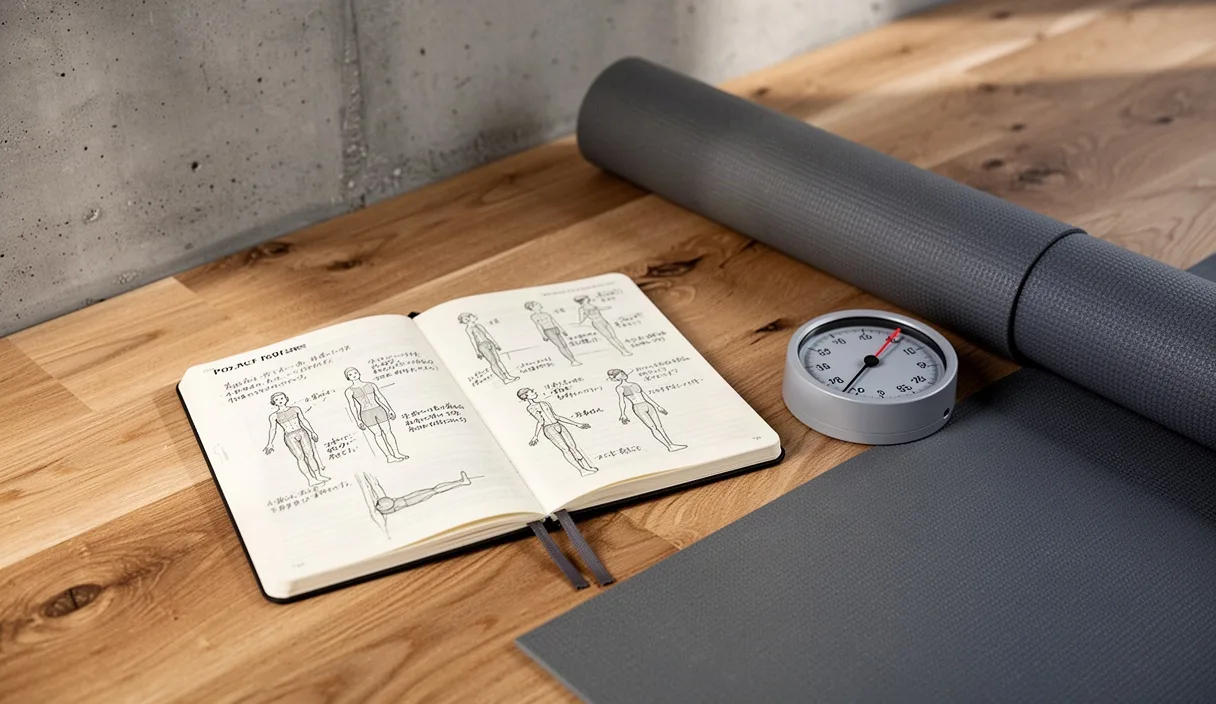
To implement this framework tomorrow, write down your sequence on an index card tonight. Pick one preparatory exercise for your ankles, one for your hips, a three-part escalating ladder, one specific peak posture, and one counter-pose. Place the card and your mat on the floor before you go to sleep so that there is zero friction when your practice window begins.
Set a timer for precisely thirty minutes and let it run without pausing. Do not improvise new postures mid-stream; follow your card, execute the repetitions as written, and hold yourself accountable to the clock. If you finish with two minutes left, sit quietly in meditation or remain in Savasana until the timer rings. Run the exact same sequence three times over the course of a single week before making adjustments. Mastery of a thirty-minute practice comes from familiarity and structural precision, not constant novelty.