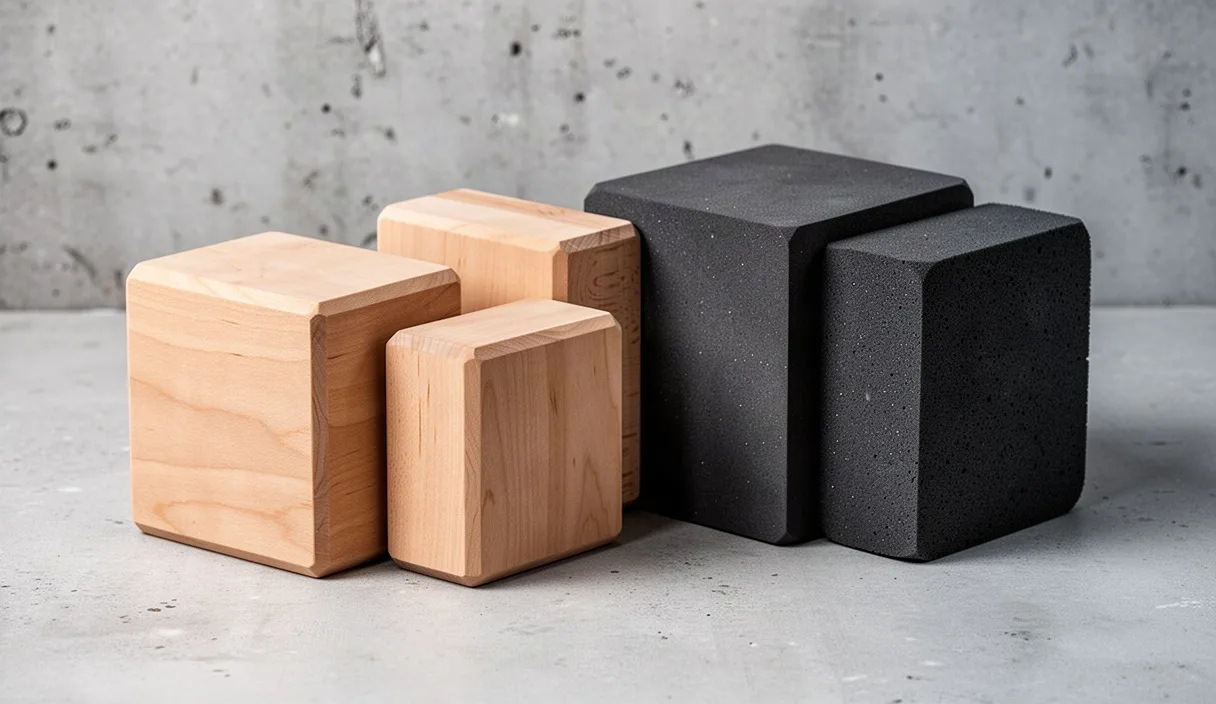
Yoga blocks serve as structural extensions of the floor. When you place body weight onto a block, you introduce a mechanical interface that alters joint angles, muscle recruitment, and center of gravity. Choosing between synthetic foam and solid wood changes how force distributes through the wrists, shoulders, pelvis, and spine. This decision determines whether an arm balance holds steady or wobbles, and whether a passive backbend relieves muscular tension or presses painfully into bone.
The market offers hundreds of variations in size, density, and finish, often obscured by vague marketing terms like "ultra-dense" or "eco-friendly." Selecting the correct prop requires an objective evaluation of material physics: compressive yield strength, friction coefficients, dimensional stability, and tactile feedback. This guide provides verifiable physical parameters and direct purchase criteria to match your equipment to your structural requirements.
Load-Bearing Ratings: Foam Density Differences
Foam blocks consist primarily of ethylene-vinyl acetate (EVA) or recycled polyethylene foam. The mechanical performance of EVA depends almost entirely on its density, measured in grams per cubic centimeter, and its hardness, quantified using the Shore C durometer scale. Standard budget foam blocks register between 30 and 40 Shore C. Under loads exceeding 40 kilograms, these low-density blocks suffer noticeable deformation. The edges compress, the surface caves inward under the heel of the hand, and the vertical axis shifts, forcing the wrist into compensatory hyper-extension.
High-density EVA blocks measure between 55 and 70 Shore C. A block in this category resists significant compression, yielding just 2 to 3 millimeters under an 80-kilogram localized point load. This minor yield provides tactile cushioning for the carpal bones without compromising structural alignment. When tested under vertical shear, high-density foam maintains perpendicular integrity, whereas low-density foam tilts laterally, which increases the likelihood of sudden balance loss.
| Foam Classification | Shore C Hardness | Typical Block Weight | Yield Under 75 kg Load | Recommended Application |
|---|---|---|---|---|
| Low-Density EVA | 30 to 40 | 160 to 220 grams | 8 to 14 millimeters | Passive restorative poses, gentle cushioning |
| Medium-Density EVA | 42 to 52 | 240 to 310 grams | 4 to 7 millimeters | General standing postures, seated support |
| High-Density EVA | 55 to 70 | 340 to 450 grams | 1 to 3 millimeters | Vinyasa transitions, supported arm balances |
To assess an existing foam block without specialized lab equipment, perform a manual thumb test. Press the point of your thumb firmly into the center of the largest face. If your thumb penetrates more than 6 millimeters with moderate effort, the block lacks the density required for stable hand support in weight-bearing postures. If the surface compresses slightly and rebounds immediately within 1 second, the material exhibits high resilience and sufficient density for active balance work.
Wood Varieties: Bamboo vs Pine Stability
Wood blocks provide an unyielding foundation. Unlike foam, timber possesses a high modulus of elasticity, meaning it does not compress under the human body. The choice between wood types comes down to weight, grain structure, and surface hardness, primarily measured on the Janka hardness scale. Pine and bamboo represent the two most common options, each offering distinct mechanical profiles.
Pine is a softwood with a Janka rating ranging from 380 to 870 depending on the specific species, such as Eastern White pine or Yellow pine. A standard 4-inch by 6-inch by 9-inch pine block weighs between 700 and 900 grams. This lighter mass makes pine more portable than hardwood, but the wood remains susceptible to denting, splintering along the edges, and gouging from floor debris. Pine blocks also tend to absorb moisture more readily, which can alter the grain texture over time if stored in humid environments.
Bamboo is not wood, but a fast-growing grass engineered into laminated structural blocks. It boasts an average Janka rating exceeding 1300, delivering exceptional surface hardness. A bamboo block of identical dimensions weighs between 1000 and 1250 grams. This additional mass provides a low center of gravity, making it virtually impossible to tip the block accidentally during dynamic weight shifts.
- Pine Blocks: Lighter to carry between locations, softer under the hands, lower cost, prone to dents, degrades faster if dropped repeatedly on hard surfaces.
- Bamboo Blocks: Heavier and highly stable, rigid grain that resists chipping, laminated multi-ply construction that prevents warping, unyielding surface that can feel harsh against prominent bones.
- Hardwood Alternatives (Maple, Birch): Extreme durability (Janka 1200 to 1450), weights exceeding 1100 grams, premium price points, virtually indestructible over decades of use.
Surface Friction and Slip Tendencies Under Load
Stability requires that the contact interface between the block, the mat, and your skin remains static under diagonal shear loads. When you press forward and down into a block during Parsvakonasana (Side Angle Pose) or Trikonasana (Triangle Pose), the prop must resist both sliding across the floor and rolling onto its side.
Closed-cell EVA foam creates a high friction coefficient against standard yoga mats made of natural rubber, polyurethane, or PVC. When dry, foam blocks grip surfaces reliably. However, because EVA is non-porous, sweat pools on the surface. When moisture accumulates between a sweaty palm and high-density EVA, the coefficient of friction drops sharply, creating a hydroplaning effect that can cause the hand to slide off unexpectedly.
Wood blocks behave inversely. A completely unfinished or lightly sanded wood block absorbs minor perspiration, maintaining consistent grip throughout vigorous movement. However, wood blocks finished with slick polyurethane varnishes or synthetic lacquers have very low friction against open-cell mats and bare hardwood floors. A lacquered wooden block placed directly on a polished studio floor can slide instantly under an angled load. Look for wood treated with natural matte oil, or use a thin rubber grip towel beneath finished wood surfaces.
Edge geometry also controls slip tendencies. Factory-cut edges with zero radius create sharp pressure points that dig into the hands and chip easily. High-quality blocks feature a chamfered or beveled edge with a radius between 5 and 8 millimeters. This rounded edge allows for secure hand wrapping during transitions without compromising the planar contact between the block and the floor.
Direct Application: Arm Balances vs Passive Rest
The choice between foam and wood directly affects mechanical comfort and musculoskeletal strain across different styles of practice. Using the wrong material for an intended purpose produces either joint instability or mechanical bruising.
Arm Balances and Dynamic Transitions
In movements like Lolasana, Bakasana, or jump-throughs, the hands require a firm ground reaction force. When you push down through the base of the index finger and thenar eminence, an unyielding surface allows immediate kinetic transfer into the serratus anterior and core musculature. A solid bamboo or hardwood block does not deform, keeping the wrist joint at a constant, predictable angle.
Foam blocks introduce micro-instability into arm balances. Even a medium-density foam block compresses unevenly under the medial and lateral sides of the hand. This instability forces the deep flexors of the forearm to fire constantly to stabilize the carpal tunnel, which accelerates muscular fatigue and places undue torque on the wrist ligaments. For students rehabilitating wrist conditions, consultation with a physical therapist is recommended before loading body weight onto unevenly compressing surfaces.
Passive Rest and Restorative Applications
In restorative yoga, Yin yoga, or supported pranayama, the body rests on props for durations ranging from 3 to 15 minutes. In supported bridge pose (Setu Bandha Sarvangasana) or supported fish pose (Matsyasana), the prop bears direct contact with the sacrum, thoracic spine, and rib cage.
Placing a solid wood block directly under the sacrum concentrates force onto the posterior superior iliac spines and spinous processes. Within 2 minutes, local tissue ischemia occurs, resulting in sharp discomfort, pain, and reflexive muscle guarding. High-density or medium-density foam compresses just enough to distribute load evenly across bone contours and surrounding fascia without collapsing. Wood blocks require thick wool blankets layered over the surface to achieve comparable pressure distribution in restorative postures.
Practical Purchase Checklist by Practice Style
Before purchasing, audit your dominant style of movement, physical travel constraints, and floor surface. Apply the following checklists to make an informed decision.
Checklist: Dynamic, Ashtanga, and Vinyasa Practice
- Verify Dimensions: Select standard 4-inch by 6-inch by 9-inch dimensions. Slimmer 3-inch blocks decrease surface area and increase tip-over risk during dynamic entries.
- Confirm Material: Choose laminated bamboo or high-density EVA rated above 55 Shore C. Avoid low-density promotional foam.
- Evaluate Mass: The block must weigh at least 350 grams (foam) or 800 grams (wood) to prevent lateral tipping during jump-throughs.
- Check Edge Chamfer: Ensure edges feature a minimum 5-millimeter bevel to protect the palmar fascia under high load.
- Surface Finish: If wood, confirm a matte, non-lacquered finish to maintain grip when palms sweat.
Checklist: Restorative, Yin, and Gentle Practice
- Target Density: Select medium-density EVA foam (42 to 50 Shore C). Avoid rock-hard wood unless you routinely wrap props in dense blankets.
- Evaluate Weight: Prioritize lighter blocks (200 to 300 grams) that can be easily repositioned with one hand while lying down.
- Assess Softness: The material must give slightly under the weight of the occiput, sacrum, or ribs without bottoming out against the floor.
- Toxicity and Odor: Verify that the EVA foam is certified free of formamide, phthalates, and heavy off-gassing, as your face will rest near the block for extended durations.
Checklist: Commuters and Studio Travelers
- Measure Carrying Weight: Two wood blocks add over 2 kilograms to a bag. Limit travel gear to high-density foam (totaling under 800 grams for a pair).
- Verify Structural Resilience: The block must resist indentations caused by straps, water bottles, and gear packed in the same bag.
Common Mistakes to Avoid
One frequent mistake is buying a 3-inch thick block to save money or space. While a 3-inch block reduces weight, its narrow footprint significantly reduces lateral stability when stood upright on its 9-inch edge. In balancing poses like Ardha Chandrasana (Half Moon Pose), a 3-inch block tips over with half the lateral displacement needed to tip a 4-inch block.
Another common error is choosing high-gloss lacquered wood for aesthetic appeal. High-gloss coatings act like glass against dry hands and synthetic mats. Without chalk or textured grip tape, glossy wood poses a constant slip hazard under horizontal shear forces.
Buying single blocks instead of matched pairs is equally counterproductive. Most structural modifications, such as shoulder elevations, seated height adjustments, and symmetry tests, require two identical props. Purchasing mismatched blocks over time leads to subtle imbalances in limb height and pelvic alignment during bilateral poses.
Finally, using low-density foam for seated pelvic support often leads to poor alignment. Under the full weight of the torso, soft foam compresses unevenly beneath the ischial tuberosities (sit bones), causing the pelvis to tilt posteriorly and rounding the lumbar spine, which negates the primary ergonomic benefit of elevating the seat.
Next Steps and Implementation
To finalize your setup, begin by assessing the equipment you already own or access at your local studio. Test both high-density foam and wood under the heel of your hand in a plank position to observe how your wrists respond to unyielding resistance versus firm foam.
If your wrists experience joint compression on rigid wood, a high-density foam block (around 60 Shore C) serves as the most versatile, balanced option. If your practice demands maximum stability for weight transfers, jump-throughs, and standing balances, purchase a pair of matte-finished bamboo blocks, and keep a folded blanket nearby for restorative applications.
Inspect existing props annually. Discard foam blocks that display permanent gouges, compression divots, or lateral warping. Clean wood blocks periodically with a lightly damp cloth and a drop of mineral oil or plant-based soap, drying them fully to preserve the natural grain traction. For individuals with chronic wrist pain, carpal tunnel symptoms, or spinal degeneration, consult a medical practitioner or physical therapist to establish safe weight-bearing protocols before loading structural props.