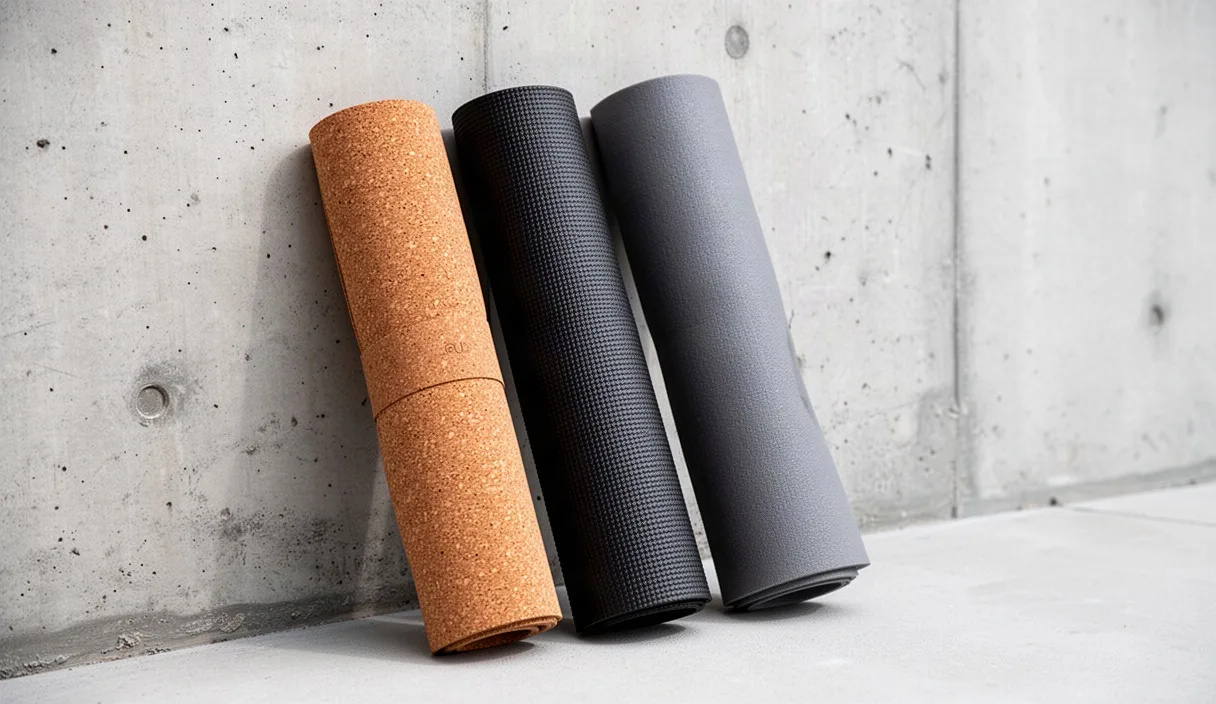
Most mat reviews focus on colorways and marketing slogans rather than polymer chemistry and mechanical behavior. When you buy an exercise mat, you purchase an interface between your musculoskeletal structure and a rigid architectural floor. The material determines friction coefficients, joint deceleration, shear resistance, and how the surface reacts to moisture. Selecting the wrong compound results in premature surface flaking, slipping joints, or a mat that gathers dust because it weighs too much to carry.
Rubber, thermoplastic elastomers (TPE), and cork represent three distinct engineering approaches to ground support. Each material uses a different cellular structure to solve the competing demands of cushioning and firm balance. Understanding how these substances perform under heat, sweat, and repeated mechanical stress allows you to select a mat based on factual performance constraints rather than retail branding.
Open-Cell vs Closed-Cell Construction Explained
The primary structural distinction across all exercise mats lies in whether the microscopic pores within the compound connect to each other or remain sealed. This architecture directly dictates how the mat handles ambient moisture, sweat, hygiene, and mechanical breakdown over years of use.
Closed-cell mats feature trapped internal gas bubbles encapsulated by solid walls of material. Standard PVC and most low-density TPE products use this configuration. Moisture cannot penetrate the surface, which keeps liquid pooling on top. This makes closed-cell surfaces simple to disinfect: you spray the surface with a mild soap solution and wipe it dry with a towel within twenty seconds. However, when sweat rests on an impermeable membrane, dynamic friction drops rapidly. If your palms sweat during intense balance holds, a closed-cell mat behaves like wet laminate flooring.
Open-cell mats operate like microscopic sponges. The internal voids link together, pulling liquids down into the interior matrix via capillary action. Polyurethane-topped mats and natural tree rubber typically utilize an open-cell structure. The surface pulls moisture away from the contact patch instantly, maintaining high surface traction even during heavy perspiration. The compromise is hygiene and long-term degradation. Open pores trap dead skin cells, salts, and sebum. Over time, bacteria multiply within the core unless you rinse and dry the mat thoroughly, a process that takes between eight and sixteen hours depending on ambient humidity.
| Feature | Open-Cell Architecture | Closed-Cell Architecture |
|---|---|---|
| Moisture Handling | Absorbs liquid into internal core | Repels liquid to surface pool |
| Traction in Heavy Sweat | Maintains or increases grip | Loses friction rapidly |
| Drying Duration | 6 to 18 hours | Immediate to 5 minutes |
| Deep Cleaning Effort | High (requires submersion or wet extraction) | Low (requires basic wipe down) |
Natural Rubber: Grip Limits and Maintenance Needs
Natural rubber mats come from the latex sap of the Hevea brasiliensis tree, vulcanized into dense, heavy sheets. Natural rubber provides the highest raw dry traction of any standard exercise material. The high density creates solid floor grounding: once unrolled on hardwood, concrete, or tile, a four-millimeter natural rubber mat will not shift, bunch, or stretch under horizontal shear forces during deep lunges.
This high density has a direct weight penalty. A standard 61-centimeter by 183-centimeter rubber mat with a four-millimeter thickness regularly weighs between 2.3 and 3.2 kilograms. If you walk or cycle to a studio, this mass creates distinct shoulder strain. Furthermore, rubber carries a distinct sulfur-like scent out of the box. While this odor dissipates over four to eight weeks of open-air exposure, sensitive individuals often find it distracting during prone breathing work.
Natural rubber breaks down under three specific environmental exposures: ultraviolet radiation, ozone, and petroleum-based oils. If you leave a natural rubber mat in a car trunk on a summer afternoon or practice in direct sunlight on an outdoor patio, the polymer chains oxidize. The surface first turns slick, then brittle, and finally sheds an ultrafine, powdery dust. Cleaning rubber demands cold water and a modest splash of white vinegar; commercial alcohol wipes, citrus oils, and essential oil sprays destroy the natural cross-linked bonds, softening the rubber until it loses structural integrity.
- Dry grip coefficient: Extremely high; bonds mechanically to dry epidermis.
- Shear stability: Exceptional; does not stretch under dynamic foot slides.
- Environmental tolerance: Poor; degrades rapidly under UV light and high temperatures.
- Typical lifespan: 2 to 4 years under regular indoor use before hardening begins.
TPE Foams: Weight Advantages and Tear Risks
Thermoplastic Elastomer (TPE) is a synthetic copolymer blend that combines the functional traits of rubber with the manufacturing advantages of plastics. TPE mats are produced using physical cross-linking rather than chemical vulcanization, which means the material can be melted down and reprocessed at the end of its functional life. Its primary appeal is an exceptionally favorable density-to-cushion ratio.
A six-millimeter TPE mat typically weighs between 850 grams and 1.1 kilograms, roughly one-third the mass of a comparable rubber counterpart. This makes TPE the standard choice for commuting. Because TPE is inherently closed-cell, it does not retain sweat, making it naturally resistant to interior fungal growth. The cushioning provides a soft, springy rebound that relieves pressure on sensitive knees and elbows during restorative ground work.
The softness that cushions your joints is also the primary structural failure point of TPE. The material has low tensile strength and modest shear resistance. If you place a TPE mat on a rough surface like aggregate concrete or an uneven deck, the bottom tears easily. Vigorous transitions where the edge of a shoe or heel pivots with body weight can cause the top layer to delaminate or tear away in chunks. TPE also exhibits lower thermal stability; leaving it rolled tightly inside a vehicle exceeding 38 degrees Celsius causes permanent crimping and curling along the outer edges that no amount of reverse-rolling will flatten.
- Dry grip coefficient: Moderate; relies on textured surface patterns rather than raw tack.
- Shear stability: Low to moderate; stretches horizontally under high lateral forces.
- Environmental tolerance: Moderate; tolerates water easily but deforms under heat.
- Typical lifespan: 12 to 24 months before compression sets create permanent indentations.
Cork and Bio-Composites: Performance Under Moisture
Cork mats utilize the harvested bark of the cork oak (Quercus suber), usually ground into fine granules and bonded to a base layer of natural rubber or dense foam. Cork contains suberin, a waxy, hydrophobic substance that changes its physical properties when wet. While rubber becomes slicker as clean water pools on a closed-cell finish, cork exhibits an inverse friction curve: moisture softens the suberin molecules, increasing surface tack and delivering superior grip as your hands sweat.
For individuals practicing in hot environments or those with naturally hyperhidrotic palms, cork removes the need for supplementary micro-fiber towels. Furthermore, cork contains natural antimicrobial phenolics that resist the development of odor-causing bacteria without heavy chemical cleaners. A simple wipe with a damp cloth after a sweat-heavy session maintains the surface reliably.
The operational weakness of cork lies in its dry friction and mechanical flexibility. When bone-dry, a cork mat provides lower grip than fresh rubber; some movers keep a small water spray bottle nearby to mist the hand-placement zones before starting. Structurally, cork bark has zero lateral elasticity. If you roll a cork mat with the cork facing inward, the compression can cause the outer bonded layer to crack along stress lines. Cork must always be rolled loosely with the organic surface facing outward to protect the structural integrity of the composite bond.
| Factor | Cork Composite | Natural Rubber | TPE Foam |
|---|---|---|---|
| Weight (Standard 4mm) | 1.8 to 2.5 kg | 2.3 to 3.2 kg | 0.8 to 1.1 kg |
| Cold/Dry Friction | Low to Moderate | Very High | Moderate |
| Hot/Sweaty Friction | Very High | High (Open-Cell) | Low |
| Abrasion Resistance | Moderate | High | Low |
Objective Selection Matrix for Your Living Space
Your living space and daily storage routine should dictate your material choice just as much as your movement style. A mat that stays on a dedicated studio floor requires entirely different properties than one stowed under a bed or slung over a shoulder on public transport.
Hardwood and Tile Subfloors
Hard surfaces expose the density differences between compounds. Natural rubber provides high subfloor dampening; it absorbs lateral energy and prevents the mat from wandering across smooth floorboards. The thin profile of a three-millimeter or four-millimeter rubber mat provides direct proprioceptive feedback without joint bottoming. TPE on hardwood cushions impact effectively, but because it is light, the entire mat can slide horizontally on dusty floors during dynamic lunges.
Carpeted Floors
Placing an exercise mat over residential carpet introduces an unstable, floating foundation. Soft TPE placed on plush carpet creates excessive instability, compressing unevenly under the wrists and ankles, which increases tendon fatigue. A stiff, heavy rubber mat or a dense cork composite bridge the carpet fibers better, creating a firmer sub-base that limits joint hyperextension during standing balances.
Small Apartments and Multi-Use Rooms
If you must unroll, pack down, and store your mat daily, weight and rolling memory dictate your daily friction. Rubber tends to retain a curl at the ends if stored tightly rolled for long durations, requiring counter-rolling before every session. TPE rolls smoothly, flattens quickly, and handles constant redeployment without wrist fatigue, provided it is kept away from radiators and direct southern windows.
Common Mistakes
- Rolling cork with the surface inward: This crushes the cellular bark structure along a concave curve, leading to horizontal fractures and delamination from the substrate within three months. Always roll cork with the wood layer facing out.
- Treating rubber with tea tree or lavender solutions: Essential oils are natural solvents that dissolve the vulcanized chains of tree rubber. The contact area softens, turns sticky, and eventually wipes away entirely, ruining the grip.
- Using TPE outdoors on aggregate concrete: Rough stone, sticks, and coarse sand act like cheese graters on soft thermoplastic foams. A single lateral pivot can gouge a centimeter-wide valley out of the foam matrix.
- Relying on cork without baseline sweat: Practicing slow, low-intensity mobility on dry cork can feel slick. If your hands stay dry, moisten your palm contact points with a few drops of water before beginning.
- Soaking closed-cell mats in tubs: Submerging composite mats with foam backings can trap water in the boundary layers between materials, causing mildew growth between the glued seams that cannot evaporate out.
Practical Next Steps
To choose the correct material without wasting capital, execute these physical checks before buying:
First, evaluate your body mechanics and perspiration rates. If your hands bead sweat within ten minutes of movement, drop standard TPE from your list; your choice sits between open-cell rubber or a cork composite. If your palms remain dry and your primary complaints involve bruised knees during floor work, prioritize a six-millimeter TPE mat for its soft shock absorption.
Second, assess your physical transit parameters. Weigh your daily bag alongside your commuting method. If your routine demands carrying your equipment over two kilometers on foot or riding a bicycle, set a strict upper mass limit of 1.4 kilograms, which naturally favors TPE formulations over solid rubber.
Third, audit your primary practice surface. Check your floor for high-gloss finishes, dust accumulation, or carpet thickness. If your home surface is polished wood, choose a heavy natural rubber base to secure your traction. If you suffer from documented joint instability or chronic wrist pain, consult an occupational therapist or sports physiotherapist to determine whether a firm platform or a compliant, energy-absorbing foam provides the safest loading angle for your skeletal structure.