In restorative yoga, props do not merely assist movement. They replace active muscular effort with passive mechanical support. When a bolster compresses excessively or forces the spine into an extreme angle, your nervous system responds by firing stabilizing muscles to protect the joints. This muscular engagement defeats the primary objective of the practice, which is deep physiological down-regulation. Choosing a bolster requires a clear assessment of geometry, internal density, and structural durability rather than color or surface texture.
Most restorative postures require holds lasting between eight and twenty minutes. During these prolonged rests, subtle equipment flaws produce pronounced biomechanical misalignments. A bolster that rolls during a supported twist introduces torque to the sacroiliac joint. A bolster that sits two inches too high behind the thoracic cage forces the cervical spine into hyperextension. This guide breaks down the physical properties of each major bolster style so you can match the prop to your skeleton, your movement restrictions, and your home or studio environment.
Bolster Shapes: Rectangular, Cylindrical, and Pranayama
The cross-sectional shape of a bolster determines its base of support and how pressure distributes across your body. The three standard geometries serve fundamentally different anatomical functions. Selecting the wrong profile will destabilize your joints or apply localized pressure where broad support is needed.
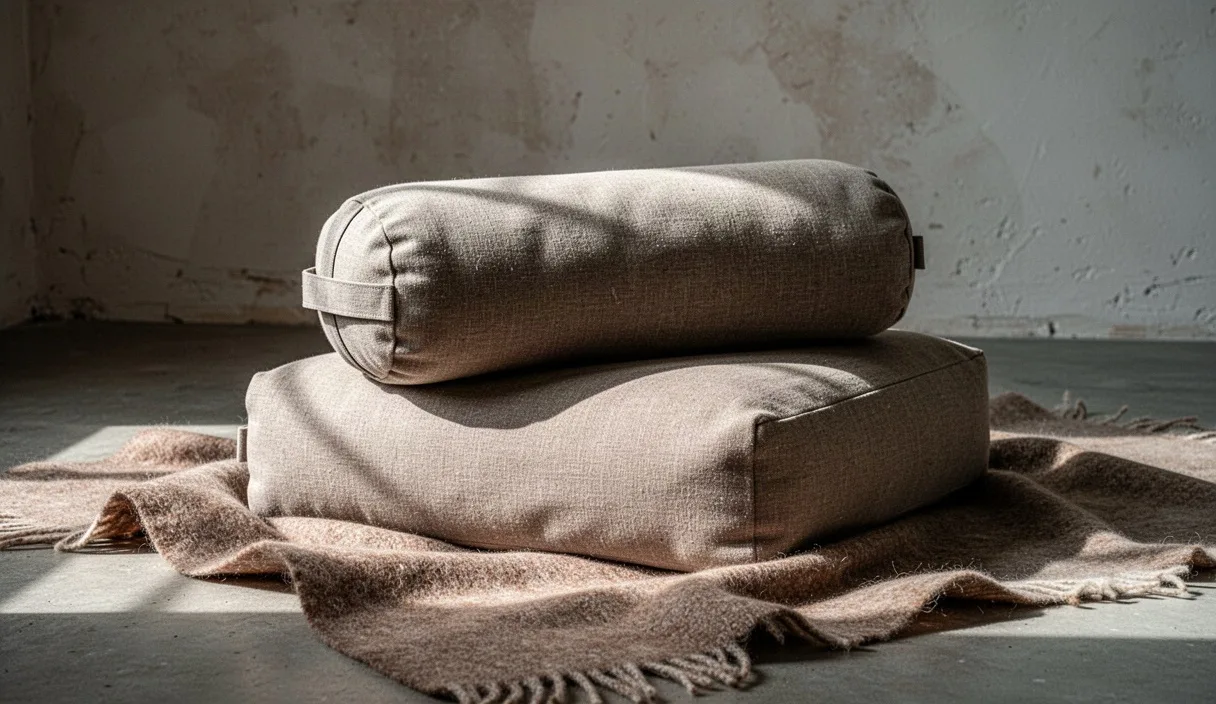
Rectangular bolsters feature a broad, flat surface on both the top and bottom. This geometry provides the highest degree of structural stability. When you place a rectangular bolster beneath the length of your spine for a supported chest opener, your scapulae rest securely on the flat plane without rolling off the edges. The flat bottom prevents the prop from shifting laterally when you recline across it for a supported twist or child's pose. Its sharp corners also offer a clean edge to tuck firmly against the lower back or beneath the sit bones to alter pelvic tilt in seated postures.
Cylindrical bolsters, often called round bolsters, mirror the natural curves of the body. Because they lack a flat base, they will roll if your weight shifts unevenly. Cylindrical models excel at opening the front body when placed horizontally beneath the thoracic spine or behind the knees in a reclined resting position. When placed beneath the knees, the curved surface fills the popliteal fossa completely, taking strain off the hamstring attachments and allowing the psoas to soften. However, when placed lengthwise under the spine, a round bolster can narrow the chest support, causing the shoulders to hang backward in an exaggerated arc that strains the anterior deltoids.
Pranayama bolsters are narrow, long, and low-profile, designed specifically for breathwork and gentle spinal extension. They measure roughly half the width of a standard rectangular prop. When positioned along the vertebral column, a pranayama bolster supports the spine while leaving the ribs and shoulder blades free to drape naturally toward the floor. This opens the intercostal spaces without thrusting the lower rib cage upward. While insufficient for supporting the full torso in seated forward folds, the pranayama shape is the premier choice for subtle chest expansion and precise breath observation.
| Shape | Standard Dimensions | Surface Contact | Primary Applications |
|---|---|---|---|
| Rectangular | 25 x 12 x 6 inches | Wide and stable | Supported forward bends, twists, long chest openers |
| Cylindrical | 28 x 9 x 9 inches | Narrow line of contact | Under-knee flexion, heart openers, hip elevation |
| Pranayama | 26 x 6 x 3 inches | Narrow and low | Diaphragmatic expansion, reclined breathwork |
Fill Materials: Buckwheat Hull vs Cotton Batting
A bolster's internal material dictates its weight, moldability, and firmness over years of use. While synthetic foam cushions exist, restorative practitioners rely almost exclusively on two traditional materials: buckwheat hulls and layered cotton batting.
Buckwheat hulls are the hard outer shells of the buckwheat seed. As a filling, they behave like dry, dense sand. When you lie down on a buckwheat bolster, the hulls shift to match your contours, creating a custom mold around your ribs, hips, or neck. Once settled, the hulls lock together to provide unyielding support that does not compress, spring back, or sag over time. This makes buckwheat bolsters ideal for stabilizing poses where you need complete, personalized grounding. The trade-off is weight and texture. A full-size buckwheat bolster typically weighs between eight and ten pounds, making it heavy to transport. The filling also rustles quietly whenever you shift your weight.
Cotton batting consists of layered, processed cotton fibers compressed into a uniform core. Cotton provides a consistent, semi-firm cushion with subtle give. It yields slightly to body weight without collapsing completely, offering a softer landing for sensitive bony landmarks like the thoracic spinous processes or the sacrum. A cotton bolster weighs between four and six pounds, making it manageable for daily studio transit. However, cotton compresses permanently with regular use. Over three to four years, the center of a cotton bolster will hollow out where the pelvis and chest regularly rest, necessitating unpicking the inner casing to restuff the batting or replacing the prop entirely.
Choosing between these two materials comes down to your need for malleability versus unified spring. If you experience localized joint stiffness and need the prop to shape itself directly to your spinal curvature, choose buckwheat. If you prefer a consistent, predictable platform that provides gentle cushioning against hard bone, choose dense cotton.
Matching Bolster Height to Torso Proportions
There is no universal bolster height that suits every practitioner. An improper match between bolster thickness and your skeletal proportions creates strain in the lumbar or cervical spine. Bolster heights generally fall between three and seven inches. Selecting the appropriate height requires evaluating your rib cage depth, thoracic mobility, and the length of your lumbar spine.
Practitioners with excessive thoracic kyphosis (a pronounced forward rounding of the upper back) require a lower bolster profile or gradual stacking. Placing a round, seven-inch bolster beneath a stiff thoracic spine forces the rib cage open too aggressively, causing the lower ribs to splay forward and the lumbar spine to pinch. If you possess a shorter torso, a tall bolster placed lengthwise will lift the pelvis off the mat or jam into the sacrum. For shorter frames or restricted upper backs, a four-inch to five-inch rectangular profile creates a manageable angle of extension.
Practitioners with broad shoulders and deep rib cages require taller props. When a broad-shouldered individual lies across a low four-inch bolster in a cross-body twist, the knees fail to reach the floor, suspending the lower back in midair. A thicker six-inch to seven-inch cylindrical or rectangular bolster bridges the distance between the limbs and the mat, neutralizing joint torque. If you present chronic structural issues, such as spinal stenosis or spondylolisthesis, consult a physical therapist before working with deep backbends on high bolsters, as excessive passive extension can exacerbate nerve compression.
Durability and Cleaning: Removable Cover Features
A restorative bolster is a long-term investment that absorbs sweat, floor dust, and skin oils. The construction of the outer casing and the inner liner determines whether your bolster lasts for a decade or degrades after a few wash cycles. You should always inspect four specific hardware and textile details before purchasing.
- Fabric Weight and Fiber: Select an exterior cover made from heavy cotton canvas, duck canvas, or cotton twill weighing at least eight ounces per square yard. These tightly woven textiles resist abrasion against yoga mats, prevent the fill from poking through, and maintain their shape when washed. Avoid plush polyester velvets, which trap lint, cause overheating during long holds, and stretch out prematurely.
- Zipper Construction: Examine the zipper length and placement. The zipper must run down the long side of the bolster, wrapped slightly around one curved edge. End-only zippers make removing a stiff cotton core nearly impossible without tearing the seams. Look for durable YKK brass or molded nylon zippers with an overlapping fabric placket. The placket conceals the zipper pull, preventing metal from scratching your skin or damaging wood studio floors.
- Inner Ticking Liners: Never purchase a bolster where the fill material floats loose inside the outer decorative cover. The bolster must have an independent inner casing, known as a ticking cover. For buckwheat models, this inner liner must feature its own secure zipper so you can add or remove hulls to customize the bolster's height and firmness as your practice evolves.
- Carry Handles: A secure handle should be box-stitched onto one or both ends of the bolster using heavy-duty thread. Test the reinforcement by pulling firmly on the handle. If the stitching pulls at the main body fabric, the handle will tear free under the weight of an eight-pound buckwheat fill.
Washing your bolster cover requires care to avoid shrinkage. Because tight covers rely on exact measurements to maintain cushion firmness, wash cotton covers in cold water on a gentle cycle. Hang the cover to air dry completely before reinserting the core. Tumble drying will shrink natural fibers by three to six percent, making it difficult or impossible to zip the cover over the core without distorting the shape.
Diagnostic Tests for Proper Chest Support
Once you acquire a bolster, you must test its relationship to your body before using it in an extended session. Set up a simple reclined chest opener: place the bolster lengthwise on your mat, sit on the floor in front of the short edge, and recline backward so your entire spine rests along the cushion.
The Occiput and Jawline Assessment
Recline completely and close your mouth without clenching your teeth. Observe the relationship between your chin and your forehead. If your chin points upward toward the ceiling, your cervical spine is hyperextended because the bolster is too tall or your thoracic spine is too rigid to drape flat. In this scenario, your suboccipital muscles contract to stabilize the head. Place a folded woven blanket beneath your skull until your forehead sits slightly higher than your chin and your throat feels relaxed. If you require more than two folded blankets to level your head, the bolster itself is too tall for your current spinal mobility.
The Lumbar Shear Check
Slide your fingers underneath your lower back just above the sacrum. When using a bolster for full spinal support, your pelvis should remain on the floor, not on the prop. However, there should not be a dramatic, unsupported drop-off between your lower ribs and the floor. If you feel intense pinching or an empty gap at the thoracolumbar junction, your bolster is either too firm or sits too far away from your hips. Adjust the prop by pulling the short edge flush against your sacrum, or place a thin folded blanket beneath your pelvis to step down the height difference.
The Diaphragmatic Breath Test
Place one hand on your upper chest and one hand on your upper abdomen just below the xiphoid process. Inhale deeply through your nose for a count of four. The breath should move downward into your belly and expand the lateral rib cage without causing your shoulders to shrug toward your ears. If you feel restricted from expanding your lower ribs, or if you feel sharp tension across the sternum, the bolster is too wide or too firm. A prop that forces your ribs into an unnatural outward flare will trigger sympathetic breathing patterns, preventing restorative rest.
Common Mistakes
- Prioritizing Bed-Cushion Softness: Buying a bolster that feels like a restful sleep support is a common error. A soft bolster flattens under twenty pounds of torso weight within five minutes, leaving your spine resting on the hard floor without mechanical elevation. Choose dense, firm props that retain their profile under load.
- Using a Round Bolster for Supported Child's Pose: Placing a cylindrical bolster between your thighs during a wide-knee child's pose forces your knees wide while offering a narrow crest of support. The torso rolls off the apex, creating neck strain when turning the head. Use a flat rectangular bolster for this posture to create a stable resting plane for the chest and cheek.
- Ignoring Fill Compaction: Practitioners often keep cotton bolsters long after the center batting has compressed into a hollow ditch. Using a sagging bolster creates a hammock effect that rounds the shoulders forward instead of opening the chest. Check your props annually and restuff the core when depth drops by an inch.
- Neglecting Lower Back Gaps in Twists: In a reclining spinal twist, practitioners frequently place a bolster under the top knee while leaving the lower ribs unsupported. This concentrates the entire twist into the lumbar spine. Always position the bolster to support both the inner knee and the lower abdomen to distribute rotational forces evenly across the spine.
Practical Next Steps
Before purchasing a new bolster, gather the props you already own to measure your personal support requirements. Fold two standard yoga blankets into firm, flat rectangles measuring twenty-four inches long and twelve inches wide. Stack them on your mat to create a four-inch platform. Recline on the stack and conduct the diagnostic tests outlined above. If your head rests comfortably and your chest opens without lower back pinching, a four-inch to five-inch rectangular cotton bolster matches your build.
If you feel you need more height under your knees or want deeper thoracic support, add a third folded blanket to reach a six-inch elevation. If this height feels stable and comfortable across your upper back, a six-inch rectangular or cylindrical bolster will serve your practice well. Take these verified measurements, select a durable cover with an inner ticking liner, and choose between the firm moldability of buckwheat or the lighter resilience of cotton based on whether your prop will remain in a home sanctuary or travel to a local studio.